Why Logistics Becomes the Biggest Growth Challenge After Your First 1,000 Orders?
As D2C brands scale, logistics challenges like high RTO, delayed COD remittance, and courier inefficiencies can impact profitability. Learn how SharkShip helps brands build a smarter shipping infrastructure.
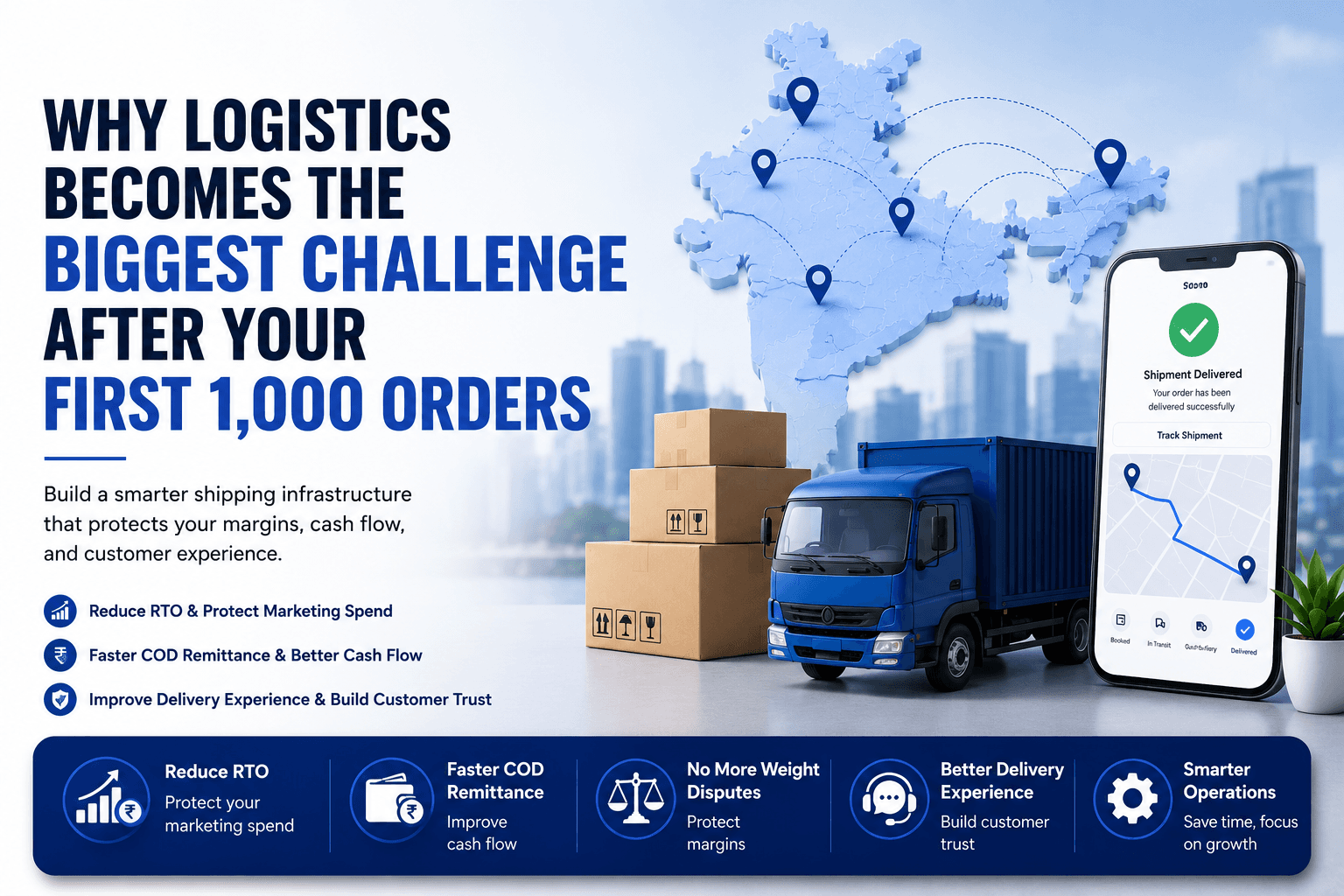
Most D2C Brands Focus on Acquiring Customers. The Real Challenge Begins After Acquisition.
For most Direct-to-Consumer (D2C) brands, the initial journey revolves around a singular objective: generating demand and securing the first few orders.
Significant effort is invested in:
→ Product development
→ Website optimization
→ Performance marketing
→ Influencer collaborations
→ Customer acquisition campaigns
When orders begin to flow consistently, it appears that the most difficult phase has been conquered.
However, founders who have successfully scaled high-growth D2C businesses often share a different perspective.
Acquiring customers may initiate growth, but operational excellence determines whether that growth is sustainable.
As order volumes increase, hidden inefficiencies within the logistics ecosystem begin to surface—often impacting profitability far more than marketing costs ever could.
The Logistics Gap That Quietly Erodes Growth
While revenue dashboards may indicate positive momentum, several operational inefficiencies frequently develop beneath the surface.
Among the most common are:
→ Courier performance varying significantly across pincodes
→ Failed delivery attempts lacking structured recovery mechanisms
→ Return-to-Origin (RTO) rates steadily increasing month after month
Individually, these issues may appear manageable.
Collectively, they create substantial pressure on margins, working capital, customer experience, and operational efficiency.
Challenge 1: Inconsistent Courier Performance Across Delivery Networks
As D2C brands expand geographically, they often discover that courier performance is not uniform across India.
A courier partner delivering exceptional service in metropolitan cities may struggle in Tier-2, Tier-3, or remote regions.
This inconsistency often results in:
→ Increased delivery delays
→ Higher customer support escalations
→ Poor delivery success rates
→ Increased Non-Delivery Reports (NDRs)
→ Elevated RTO percentages
Without data-driven courier allocation, brands frequently continue shipping through underperforming networks, unknowingly increasing logistics costs and customer dissatisfaction.
The Strategic Impact
Every delayed shipment directly influences:
→ Customer trust
→ Repeat purchase probability
→ Brand reputation
→ Customer Lifetime Value (CLTV)
In a highly competitive D2C landscape, delivery experience is no longer merely an operational metric—it is a customer retention metric.
Challenge 2: Failed Deliveries Without Structured Recovery Processes
A failed delivery does not necessarily represent a lost sale.
Yet for many brands, that is precisely how it is treated.
Common delivery failures occur due to:
→ Customer unavailability
→ Address discrepancies
→ Delivery rescheduling requests
→ Communication gaps
Without an effective NDR management framework, these orders frequently progress directly toward RTO.
The Financial Consequences
Every avoidable return generates:
→ Additional forward shipping costs
→ Reverse logistics expenses
→ Delayed revenue realization
→ Increased inventory holding periods
→ Additional operational workload
A structured NDR recovery process can recover a significant percentage of orders that would otherwise contribute directly to RTO losses.
Challenge 3: Rising RTO Rates and Their Impact on Profitability
Return-to-Origin remains one of the most underestimated challenges in Indian eCommerce logistics.
Many brands experience RTO rates ranging between:
→ 15%–20% during early growth stages
→ 25%–35% as shipment volumes increase
The concern is not merely the percentage itself.
The concern is the cumulative financial impact.
Every RTO Shipment Typically Involves
→ Customer acquisition cost already incurred
→ Forward shipping charges
→ Reverse logistics costs
→ Packaging expenses
→ Inventory blockage
→ Delayed cash realization
When examined collectively, high RTO percentages can consume a substantial portion of a brand's operational profitability.
The Hidden Costs Most D2C Founders Do Not Measure
While leadership teams closely monitor metrics such as:
→ Revenue growth
→ Return on Ad Spend (ROAS)
→ Conversion rates
→ Customer Acquisition Cost (CAC)
Several logistics-related costs often remain untracked.
These hidden leakages accumulate quietly and significantly.
High RTO Can Nullify Marketing Investments
Brands invest heavily in acquiring customers.
However, when orders return undelivered:
→ Advertising budgets generate no realized revenue
→ Shipping costs are incurred twice
→ Customer acquisition costs remain unrecovered
→ Operational resources are consumed without generating business value
In effect, high RTO directly undermines marketing efficiency.
Delayed COD Remittance Restricts Working Capital
Cash-on-Delivery continues to account for a significant portion of Indian eCommerce transactions.
While COD increases conversion rates, delayed remittance cycles often create liquidity challenges.
This directly impacts a brand's ability to:
→ Replenish inventory
→ Scale advertising campaigns
→ Manage vendor payments
→ Support business expansion
For growth-stage D2C businesses, cash flow velocity is often as important as revenue growth itself.
Weight Discrepancies Can Quietly Reduce Margins
Many brands overlook the financial implications of courier weight disputes.
Incorrect billing adjustments can result in:
→ Unnecessary logistics expenditure
→ Reconciliation challenges
→ Margin erosion across thousands of shipments
Industry observations suggest that unresolved weight discrepancies can impact profitability by as much as 5–8% annually.
Operational Coordination Consumes Valuable Leadership Bandwidth
As shipment volumes grow, internal teams often spend increasing amounts of time managing logistics-related issues.
This includes:
→ Courier escalations
→ Shipment tracking
→ Delivery exceptions
→ COD reconciliation
→ Customer support coordination
These are resources that could otherwise be allocated toward:
→ Product innovation
→ Market expansion
→ Customer acquisition
→ Brand building initiatives
Operational complexity should never become a barrier to strategic growth.
Why High-Growth D2C Brands View Logistics as Infrastructure?
One characteristic consistently distinguishes scalable brands from those struggling to maintain momentum.
Successful brands stop managing shipping as a daily operational activity.
They begin investing in logistics as a long-term growth infrastructure.
A robust logistics infrastructure enables businesses to:
→ Reduce RTO percentages
→ Improve delivery success rates
→ Accelerate COD realization
→ Optimize courier allocation
→ Improve customer satisfaction
→ Protect contribution margins
→ Scale efficiently across India
The objective is not simply shipping products faster.
The objective is building a system capable of supporting sustained growth.
Building a Modern D2C Logistics Infrastructure
Today's eCommerce environment demands far more than basic shipment booking capabilities.
Brands require:
Intelligent Courier Allocation
→ Automated courier selection based on pincode performance
→ Cost optimization across delivery networks
→ Improved delivery success rates
Structured NDR Management
→ Automated customer communication
→ Delivery reattempt workflows
→ Reduced RTO exposure
Faster COD Reconciliation
→ Improved cash flow visibility
→ Quicker access to working capital
Shipment Analytics & Visibility
→ Performance tracking
→ Operational insights
→ Data-driven decision making
Nationwide Reach
→ Reliable delivery coverage across metropolitan, Tier-2, Tier-3, and remote locations
How SharkShip Enables Sustainable D2C Growth
At SharkShip, we believe logistics should function as a strategic advantage rather than an operational burden.
Our platform is designed to help D2C brands establish a scalable shipping infrastructure that protects profitability while enhancing customer experience.
With SharkShip, businesses gain access to:
→ Multiple courier partners through a unified platform
→ Intelligent courier allocation capabilities
→ RTO reduction support mechanisms
→ Structured NDR management workflows
→ Faster COD remittance processes
→ Real-time shipment visibility
→ Comprehensive logistics analytics
→ Pan-India delivery coverage
Most importantly, SharkShip enables founders and growth teams to focus on scaling their business while the logistics ecosystem operates efficiently in the background.
Build a Smarter Shipping Infrastructure with SharkShip
Reduce RTO. Improve delivery success. Accelerate COD realization. Optimize logistics operations.
Scale your D2C business with the shipping infrastructure built for growth.